The 7 Rarest Books in the World
27/10/2026
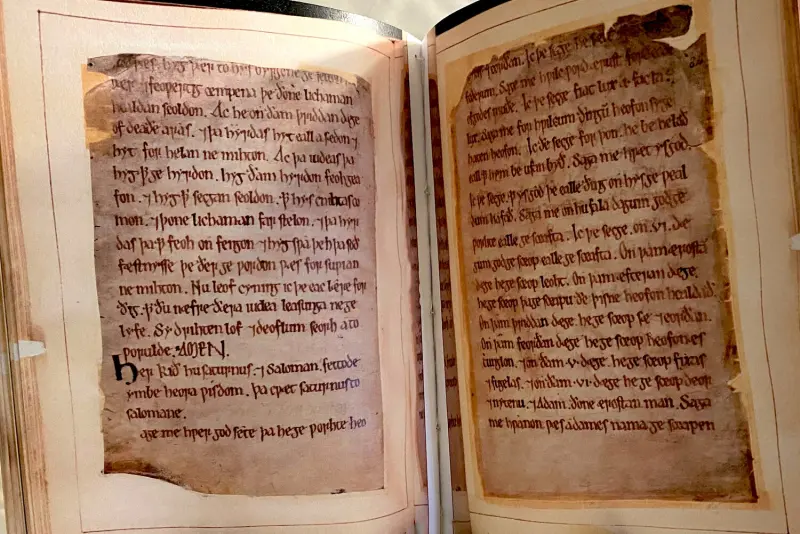
The Nowell Codex – Beowulf
In 1731, fire swept through the shelves of the Cotton Library and flames approached the pages of the Nowell Codex, which contained the only surviving copy of Beowulf - one of the most significant texts of Anglo-Saxon literature. Fortunately, the manuscript survived and became part of the Cotton Library as one of three founding collections of the British Museum. The work became so important that the Old English canon is unimaginable without it. Currently preserved in the British Library, the text tells the story of Beowulf, including his dramatic victory over the monster Grendel and his mother, and his battle with the dragon.
Omar Khayyam's Rubaiyat
One of the most luxuriously created books was swallowed by the waves when it sank with the Titanic. Years later, a second copy of the book was destroyed during the London Blitz of World War II. After such a dramatic history, it's almost incredible that Sangorski and Sutcliffe's legendary edition of Omar Khayyam's Rubaiyat survived at all, though the third (the only surviving copy of the book) is now kept in the British Library. The original text was decorated with 1,050 precious stones, approximately 9 square meters of gold leaf, and 5,000 pieces of leather.
Codex Tchacos - The Gospel of Judas
Discovered in the Egyptian desert, the Gospel of Judas was lost for more than 1,700 years. Part of the Codex Tchacos, an early Christian manuscript written in Coptic, the gospel remains the first and only discovered version of this text. The manuscript containing the story of Jesus's crucifixion reinterprets the story of the apostle Judas Iscariot in a new way, and in this version, Christ himself instructs his friend to betray him. The manuscript is presumably a copy of the original Gospel of Judas, which is now lost.
The Voynich Manuscript
While some books slowly reveal their secrets, the Voynich Manuscript guards the information contained within it like a sphinx. Written in cipher in an unknown language and surrounded by assumptions and hypotheses, the text remains largely incomprehensible to this day. Although it is presumably a work of science or magic, most pages contain scientific and botanical illustrations, the exact meaning of the Voynich text continues to amaze experts. Overall, authorship remains questionable and origins are obscure.
Da Vinci's Codex
Leonardo da Vinci's neat and unclear handwriting slants across the page. The complex, hard-to-decipher records left by the artist are entirely executed in mirror writing. This may have been the result of the artist's secretiveness, according to popular theory, and da Vinci may have been trying to hide his works from curious eyes. Today, the manuscripts, which include the Forster Codex, the Atlantic Codex, and the Arundel Codex, among others, remain in high demand. In 1994, da Vinci's Leicester Codex made history as the most expensive manuscript sold at that time, when Bill Gates purchased it for $30.8 million.
Birds of America
Only 120 complete copies of "Birds of America" exist - a very small number for a printed book (for comparison, there are 235 known copies of Shakespeare's First Folio). This, along with its life-size illustrations and desirability, has made it a particularly rare and valuable text. The plates executed by John James Audubon over nearly twelve years are considered among the most impressive and beautiful specimens in natural history.
Pliny the Elder's Historia Naturalis
Created only three decades after the invention of the printing press, the first edition of Pliny's Historia Naturalis is remarkably rare, with only 100 copies. Known for its 27,000 entries that include fantastic stories, Pliny's text is not only one of the rarest printed texts, but also one of the most interesting. On its pages you will find birds, beasts, and monsters, including humans with eyes on their shoulders, dragons, and phoenixes.